
Starting points for the City of Heinola’s skills management development project
Working with the City of Heinola, we experienced how co-creation builds a shared understanding of the current state of skills development and management, deepens knowledge from different perspectives, and enables solutions to be developed and tested with management, other staff and stakeholders alike.
The City of Heinola sees skills development and its systematic management as important factors in a rapidly changing operating environment. The city identified a need to develop a staff skills management model that strengthens employee wellbeing and improves management practices.
The development project launched in Heinola, Learning and skills as the foundation for staff wellbeing and good leadership, aimed to create a consistent, forward-looking skills management operating model for the entire organisation.
The model is intended to provide a foundation for developing the skills of staff and management and to help managers assess and identify skills needs. It also aims to make it easier to anticipate future skills requirements and potential challenges to work ability.
"During the project, we wanted to find ways to identify future skills requirements and gain a city-wide view of the skills management operating model," summarises Annika Blom, HR Manager at the City of Heinola.
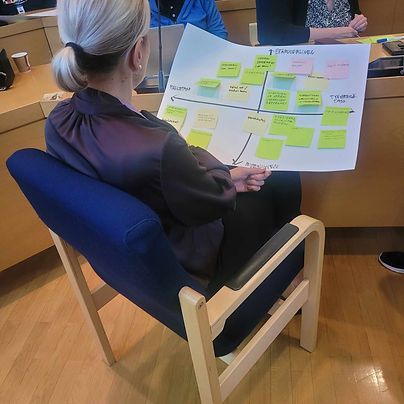
The work to develop the skills management operating model was also guided by the aim of harmonising practices across the city’s different service areas. The goal is for every City of Heinola employee to be able to develop their skills in line with their own goals, while keeping organisational and unit-level objectives clearly in mind.
Project progress
The first phase mapped existing learning and skills development practices and identified the organisation’s most important areas of competence, drawing on both the strategy and staff surveys.
On this basis, the City of Heinola’s learning vision was defined and goal-setting began for a consistent, forward-looking skills management operating model. These goals were brought into units and teams using scalable dialogue models that translated the city’s strategy into team-level skills.
The second phase focused on building the skills management operating model. The aim was to create a clear, coherent model that provides tools and supports managers in managing skills and enabling continuous learning within their units.
Heinola then turned its attention to methods and opportunities for workplace learning. The aim was to encourage recognition that employees do not learn everything in a classroom: work itself has enormous potential to support learning. In the workshops, we transformed the work environment into a learning environment and brainstormed ways to enhance and develop workplace learning as part of the pilot launched in the next phase.
The Workplace Learning in Teams 2.0 pilot began with a total of seven teams. Its aim is to experiment and learn, among other things:
-
How to communicate the organisation’s skills development goals to teams
-
How managers can help their teams set shared skills development goals linked to the strategy
-
How learning, skills development and their assessment can be more strongly integrated into development discussions
-
What practices can support workplace learning in line with the new model
The pilot also tests a new development discussion model, which Heinola has named the success discussion. These discussions seek to place even greater emphasis on employees’ successes, strengths and achievements. A key aim is to provide positive feedback and strengthen employees’ motivation and job satisfaction by recognising their contributions and achievements and jointly defining directions for development.
Success discussions are intended to strengthen the employee experience, among other things, and help employees identify their strengths and directions for development in an era defined by continuous change.
Through various measures, the new model more actively encourages staff to identify their skills and draw up their own learning plans. They receive support and coaching from their managers, who are equipped to support learning in practice in accordance with the 70-20-10 model and to support their professional development.
The work was carried out in close collaboration with the City of Heinola’s key people to ensure that the operating model genuinely fits and supports the city’s everyday work.
In conclusion
The project produced a comprehensive, systematic skills management operating model for the City of Heinola. It offers every employee and unit opportunities to develop their skills consistently while taking the distinctive characteristics of each service area into account.
The model was complemented by jointly agreed and entirely new practices and processes, increasing consistency and transparency between service areas. Over the long term, the project’s effects are expected to be reflected in staff commitment, the experience of meaningful work and the quality of leadership, and consequently in a positive sense of career wellbeing.
If you would like to hear more about the measures developed and follow the pilot’s progress and Heinola’s next steps, stay tuned to what the city is doing! The city’s HR Manager Annika Blom, Director of Administration and Development Hanna Hurmola-Remmi and HRD Specialist Elina Haverinen are excellent sounding boards on all aspects of organisational learning. This is an exciting experiment that the rest of us can learn from too!
Would you like to hear more about us and our work?
Kuulas & Co Oy. Kuulas & Co is a design agency and coaching company specialising in organisational development. We help our clients align strategic skills needs with employees’ career and learning aspirations. At the same time, we coach employees to become insightful developers of their own work and workplace communities.
Let’s shape the future of work and learn together!