
The pace of change in the world challenges us as individuals and organizations alike. Sometimes we must adapt rapidly to major upheavals. These changes in the external operating environment often challenge organizations to change their internal practices and processes too.
Kirsi Piha calls it an arrhythmia when an organization changes more slowly than its environment. An organization's internal operating cycles can also run at different speeds, requiring different paces of skills development, summarizes Merja Soosalu, HR Director at Helsinki Region Environmental Services.
Changes in our operating environment always require us to look at our activities with fresh eyes, and often this also means learning something new. Continuous learning and skills development are not merely tools for individual competence and career development: they are also key factors and prerequisites for organizational vitality and success.
HSY and the renewal of skills management
Changes in the operating environment have also been identified as a key driver of change at HSY. The transformation of work is a central theme in HSY's new strategy, alongside how to continue attracting new talent and strengthen retention so that current employees find their work even more inspiring.
HSY also felt a need to take a more comprehensive look at learning and skills development practices and to adopt approaches found across the organization more systematically when introducing a new digital learning platform.
We joined this work to model the components of skills management and approaches to building a capability model as part of the emerging structures and processes.
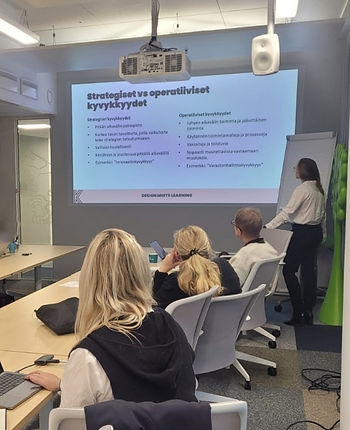
Strategic skills development and management are critical for today's organizations. They ensure that employees' skills not only meet current needs but also guide the organization towards its future goals while nurturing its capacity for change.
By connecting an organization's skills management practices, structures, and processes to its strategy, and creating ways to embed the resulting practices in everyday work, we make skills development and its management purposeful and clear. Clear goals help employees develop their skills and managers lead that development, and make it easier to evaluate learning's impact.
From analyzing the current situation to tailored solutions through design
We used a design approach to plan the skills development and management model. Development began by identifying the organization's current situation: how do employees experience learning and skills development, and how can we, as an organization, manage and plan them more purposefully while anticipating future skills needs?
Interviews with employees and management, together with a survey, deepened our understanding of learning and skills development at HSY. They showed that HSY employees generally have good opportunities to develop their skills and learn new things, and that the organization's learning culture was seen as having a positive effect on their skills development. However, consistent skills management practices were needed. Both employees and management wanted clearer guidelines and goals for skills development and management.
Based on the assessment of the current situation, we defined design principles that guided development throughout the project. We used a participatory design approach, delivered through a series of workshops and consulting for the management team, managers, and employees.
Co-development enabled broad participation by employees in different roles and organizational units. Participatory co-design methods aimed to build a shared understanding of the importance of skills development for both individual employees and organizational units, and to secure broad commitment from everyone affected by the development activities.
Identifying strategic capabilities
Work with the management team began by identifying and defining strategic capabilities. Using HSY's strategy as our starting point, we considered what skills HSY needs to achieve the goals set out in it. Strategic capabilities are an organization's key areas of expertise, encompassing skills, knowledge, and technologies. Identifying them helps determine which skills are critical to success now and in the future. Deliberately developing capabilities translates strategy work into practice.

In a workshop for managers, strategic capabilities were assessed from the perspectives of skills management and line management. In a workshop for employees, we also identified different ways of learning and developing skills at HSY using the 70–20–10 model.
The 70–20–10 model is a learning and development model that emphasizes the importance of different ways of learning and provides a framework for implementing related activities. It describes skills development through doing work (70), interacting within the workplace community (20), and formal training (10). The model highlights the importance of experiential and social learning in professional development and encourages organizations to support continuous learning in the work environment.
Building a capability model and piloting skills discussions
Building organizational capabilities aims to develop the skills and expertise an organization needs to succeed and achieve its goals. A capability model serves as a kind of map, guiding the organization on which capabilities it needs and how to develop them. It helps the organization plan and steer this development process.
An iterative, experimental approach to development is part of design. As part of the project, we designed a pilot to support the building of HSY's capability model. We tested team-specific skills discussions that also considered skills in relation to units' strategic goals and future skills needs.
The discussions produced good results and were seen as a necessary addition from a skills management perspective too.
Building capabilities is an essential part of organizational success, helping improve efficiency and productivity and ensuring flexibility and adaptability in a changing operating environment.
In conclusion
The journey towards a culture of continuous learning, including defining the capabilities needed, requires determination and a systematic approach. Co-design aimed to foster commitment and a shared understanding of the importance of skills development to both individual and organizational success. Involving employees in planning learning and skills development also promoted collaborative learning and cooperation across HSY's organizational units.
HSY's approach to building a model suited to its needs shows how skills development can become more purposeful and support the implementation of organizational strategy. This kind of systematic, continuous development creates a strong foundation for success, renewal, and the ability to respond to future challenges. Building capabilities takes persistence and, to succeed, a wide range of expertise, processes, and structures.
We would like to warmly thank the whole HSY organization, especially Merja Soosalu and Heidi Tähtinen, for their trust and excellent collaboration, and for the lessons we were able to gather and develop together.
Kuulas& Co Oy. Kuulas & Co is a design agency and coaching company specializing in organizational development. We help our clients align strategic skills needs with employees' career and learning aspirations. We also coach employees to become insightful developers of their own work and workplace communities.
Join us in shaping the future of work and learning together! Find out more about what we do at: www.kuulas.co