
Skills development is a critical part of organizational success, but how can we ensure that employees and managers have the best opportunities to learn and develop? One modern, widely accepted approach to skills development is the 70-20-10 model, which offers a clear framework for structuring learning effectively and productively.
What is the 70-20-10 model?
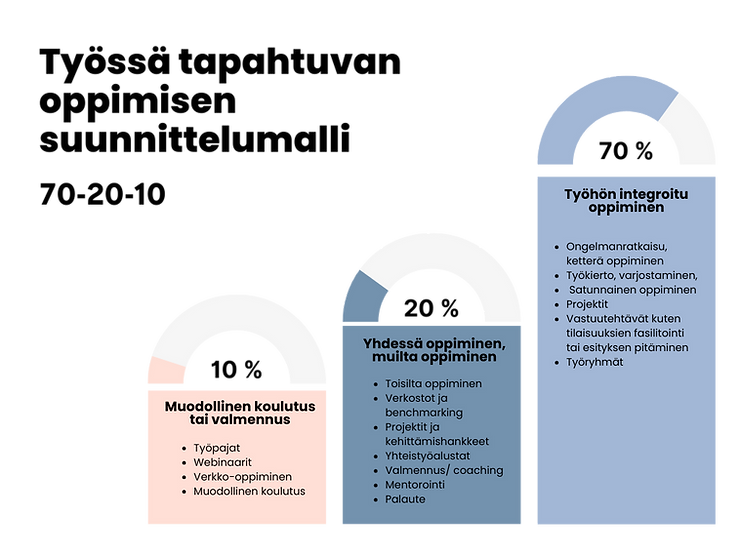
The 70-20-10 model draws on applied research into how people learn and provides a tool for planning skills development activities. It divides workplace learning into three components:
-
70% of learning takes place through work: This is what is known as "learning on the job," through everyday tasks, challenges, projects, and problem-solving. This learning should not simply be incidental experience: it needs to be structured and purposeful. Employees should have opportunities to try new things and receive feedback that supports their development.
-
20% of learning takes place through other people: This includes mentoring, informal peer support, and collaboration, where learners can share ideas and get advice from others. Organizations need to create structures that support this, for example by encouraging peer learning or using mentoring.
-
10% of learning takes place through formal training: Formal training, such as courses and seminars, often involves more than an investment of time. This share of overall learning should therefore focus on acquiring and deepening knowledge and skills that would otherwise remain missing, through precisely targeted, goal-oriented learning. Which essential skills do we need that we cannot learn from one another or by doing our work?
70%: Learning integrated into work
Most learning takes place alongside work, but to be effective it needs to be planned and structured. This might mean giving employees new challenges to solve or opportunities to participate in projects that require new ways of thinking and new skills. Feedback is also important, helping employees reflect on their experiences and continue developing.
20%: Learning together, learning from others
Collaboration and interaction with others are key elements of learning. Mentoring, peer support, and workplace collaboration help employees share knowledge and learn from one another. Organizations should encourage this kind of learning, for example by arranging ways for more experienced employees to help newcomers.
10%: Formal training or coaching
Formal training, such as courses and seminars, remains an important and significant part of learning, even though it accounts for only 10% in this overall learning model. This training should be well planned and targeted, supporting the organization's goals. It is important to integrate formal training into a broader learning strategy so that it supports employees' overall development.
Why does the 70-20-10 model work?
The 70-20-10 model gives organizations an effective tool for planning skills development. It helps bring formal training, workplace learning, and learning through others together into a comprehensive, productive process.
Although applying the model takes time and resources, it can deliver significant benefits, such as a more engaged and effective team that can assess its own skills and set learning goals.
The model is a widely accepted framework that has proved useful for planning learning.
Its strengths are its flexibility and its focus on other ways of learning alongside formal learning. At the same time, it requires organizations to commit to creating structures and a culture that support learning at every level.
The percentages underlying the 70-20-10 model are generalizations rather than findings from rigorous scientific research. The model has been criticized for presenting these proportions as overly precise, prescriptive truths, when learning is actually more individual and diverse.
The model is best seen as a framework offering guidelines for workplace learning, with its content tailored to each setting and need in line with the organization's culture and practices. Applying it requires flexibility and adaptation to different learning needs and situations.
Is now the right time to get your learning structures in place?
The 70-20-10 model is more than a learning strategy: it is a mindset that can bring entirely new perspectives to how your organization develops its skills and prepares employees to anticipate future skills needs. It encourages active learning and collaboration and emphasizes continuous development in everyday work. When your organization adopts this model, you will find that learning is no longer a separate function but a natural part of doing the work and growing as a team.
For the model to work, the structures and processes that support this kind of learning must be in place. Have you allocated enough time for learning in everyday work?
Now is a good time to assess where and how your organization supports everyday learning and which parts of the model could be improved. Remember that the aim of the 70-20-10 model is not only to make learning more effective, but also to strengthen the workplace community and secure the organization's future competitiveness.

Elina Pihlantie
Skills development strategy
Team learning
Strategic learning
Learning organizations
Kuulas& Co Oy. Kuulas & Co is a design agency and coaching company specializing in organizational development. We help our clients align strategic skills needs with employees' career and learning aspirations.
Join us in shaping the future of work and learning together! Find out more about what we do at: www.kuulas.co