
The traditional model of organisational learning has been based on the idea that skills needs can be anticipated and skills updated in a controlled way. To achieve this, academy models, training programmes and competency matrices have been created to develop employees’ skills according to long-term plans.
This approach worked in an era when job roles were more stable and change was slower and more controlled. With working life changing faster than ever, the traditional learning model can feel too slow, rigid and disconnected from everyday work to meet such a pressing need for renewal.
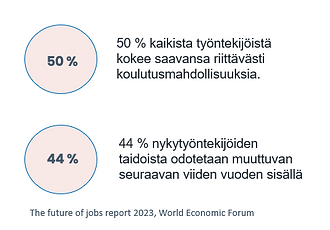
Almost 50% of employees’ skills will need to be renewed in the coming years. In working life, simply knowing how to do something is no longer enough—the ability to learn and renew yourself matters more.
An organisation’s competitiveness now depends on one thing: how quickly it can learn and renew itself.
What structures and processes will enable us to renew ourselves and ensure that our skills meet the demands of tomorrow’s operating environment?
A shift in the learning paradigm
A learning paradigm refers to an understanding of how learning happens most effectively. The shift in the learning paradigm taking place today challenges traditional ways of organising learning and often calls for broader changes to an organisation’s structures, processes and learning culture.
A shift in the learning paradigm requires organisations to be flexible, open to new ideas and willing to invest in employees’ development, not just here and now but over the longer term. This approach not only improves the performance of individuals and teams, but also enables a faster response to changes in the business environment.
When an organisation understands its strengths and areas for development as a whole, it can allocate resources effectively and take advantage of new opportunities. This flexibility and adaptability are vital, especially in a rapidly changing market.
Are our structures in place? Do we know how to manage skills development strategically across the board?
A systemic approach to developing and managing skills
We humans act according to structures. If we want to bring about a change in behaviour, we must change the structures and processes that guide our actions. Changing structures, however, requires the insight to answer questions about what needs to change, why and how.
Structural changes therefore cannot be the first place to start when updating our approaches to managing and developing skills for today’s needs. Change on this scale requires a systemic approach.
A systemic approach offers a way to view an organisation as a holistic system, in which all parts—individuals, teams, structures, processes and culture—are closely interconnected and influence one another. In this model, leadership and strategic planning aim to create conditions in which continuous learning and skills development support the organisation’s strategic goals and adaptability.
A systemic approach to learning also supports leadership and the development of company culture: leaders who understand the connections and relationships of influence within their organisation are better able to guide the development process and create an environment where continuous learning is a natural part of daily work.
How does a co-created strategic learning operating model help?
A systemic approach to organisational learning, combined with a design-based approach to development, strengthens the entire organisation’s collective skills, supporting its long-term competitiveness and sustainable development.
Co-designing an operating model for strategic learning is a process in which the organisation’s skills development activities and approaches to managing learning are linked to strategy and distilled into a practical operating model.
Working together to develop the model creates a shared understanding of the current situation, deepens knowledge from different perspectives, and enables solutions to be developed and tested across disciplines. Co-creation offers a way to involve all the stakeholders needed and ensure that the skills of the whole organisation are used in the development work.
A co-created model does not offer a single formula or ready-made answer, but a process through which organisations can create a flexible, effective learning structure suited to their needs. It is based on the idea that learning is not the responsibility of an individual or HR, but a shared capability of the entire organisation, to be led, supported and developed together.

In our experience, a good starting point for building operating models is to clarify what we think about learning and build a picture of the skills we aspire to have. It then becomes easier to consider what it will take to reach the goal set out in the vision.
Once we have taken these crucial first steps, we begin planning a co-creation process that responds to each organisation’s individual needs. Co-creating an operating model often includes the following, among other things:
-
Setting goals in line with the skills vision
-
Ensuring shared strategic goals throughout the organisation
-
Reviewing structures, processes and ways of working, and designing those needed
-
Aligning organisational strategy and skills—the so-called strategic capabilities
-
Integrating learning into team activities and applying the 70-20-10 model
-
Tools, structures and processes for managing learning
We advance the work through co-creation, facilitation and learning through experiments. We also use coaching and consulting.
You can read more about the strategic management operating model via the link below and leave a contact request at the bottom of the page if you would like to discuss and exchange ideas about how best to get started with the elephant sitting on your own desk. That way, we learn together too: https://www.kuulas.co/strategisenoppimisentoimintamalli

Elina Pihlantie
Organisational developer
Learning organisations
Strategic learning
Employees’ career and learning aspirations

Kirsi Kaunissaari
Organisational developer
Strategic learning
Future skills
Strategic skills management